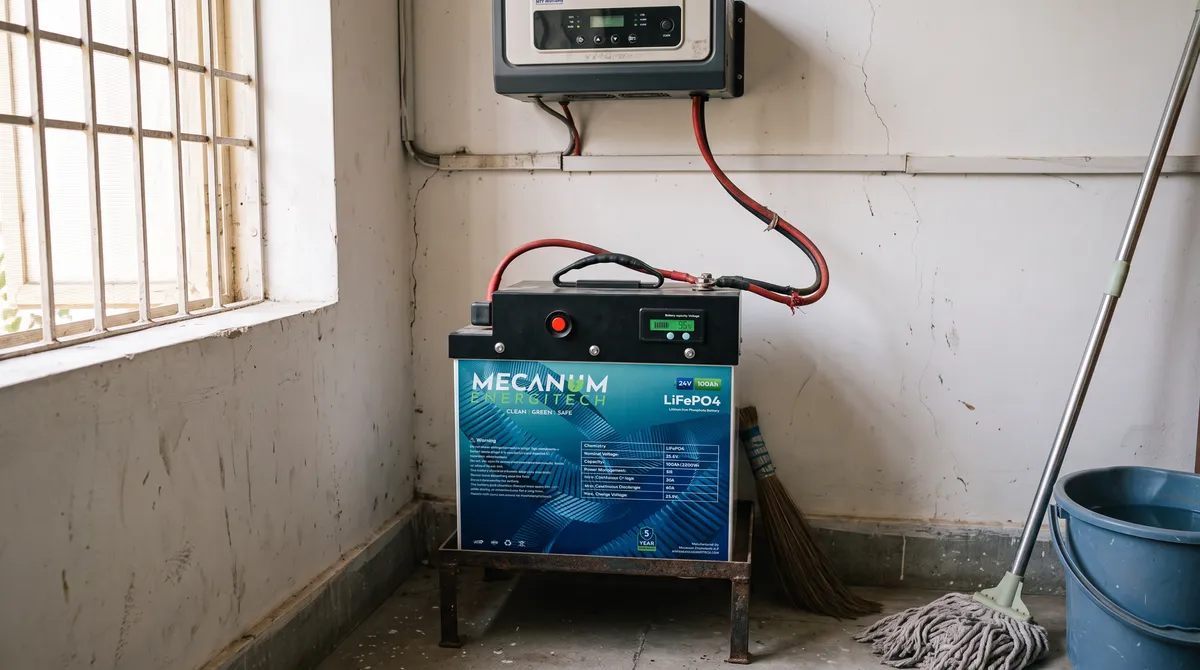
Battery Fires and Thermal Runaway: Why Chemistry Matters Inside Your Home
Many homeowners worry about lithium battery fires after seeing EV news headlines. Here is why Lithium Iron Phosphate (LiFePO4) cannot suffer the same thermal runaway.
When a homeowner in India looks into replacing their inverter battery with lithium, the first hesitation is almost always safety. Everyone has seen viral videos of electric scooters smoking on a roadside in May heat.
The confusion happens because people treat "lithium-ion" as a single product. In reality, lithium batteries use completely different chemical compounds inside the cathode. Putting an NMC laptop or scooter battery in the same mental category as an LFP (LiFePO4) home backup battery is like comparing petrol to diesel.
The Chemistry Difference: NMC vs LiFePO4
Two-wheeler EVs and mobile phones mostly use NMC (Nickel Manganese Cobalt) or LCO (Lithium Cobalt Oxide) cells because they pack slightly more energy into very tiny spaces.
However, NMC and LCO cells have a structural weakness: when crushed, overcharged, or exposed to extreme summer temperatures, their cathode breaks down around 180°C to 210°C and releases pure oxygen. Oxygen feeds fire inside a sealed metal case, triggering an unstoppable chain reaction called thermal runaway.
LiFePO4 (Lithium Iron Phosphate) uses an olivine crystal structure bound tightly by phosphorus-oxygen covalent bonds. Even under physical puncture or severe thermal abuse, it does not release oxygen inside the cell until temperatures exceed 270°C to 300°C, and even then, it does not combust violently.
Why Prismatic Cells Are Safer Than Cylindrical Packs
Inside a battery box, manufacturers choose between welding hundreds of small cylindrical cells (like oversized AA batteries) or using large Grade-A Prismatic cells.
- Hundreds of Cylindrical Cells: Require thousands of spot-welds. In a vibrating home inverter cabinet or hot wall mount, one loose weld increases resistance, creating a localized hot spot.
- Grade-A Prismatic Cells (Used by Mecanum): Feature solid aluminum casings, screw-bolted busbar connections, and integrated top safety pressure vents. Heat dissipates evenly across flat aluminum walls, eliminating hot spots entirely.
What Our Built-In Smart BMS Actually Monitors
Even the safest chemistry needs electronic supervision, especially with Indian utility grids where voltage spikes from 160V to 280V happen daily. Every Mecanum battery includes a solid-state Battery Management System (BMS) that tracks:
- Over-Voltage Cutoff: Disconnects charging instantly if a faulty inverter attempts to push past 14.6V (on 12V packs) or 29.2V (on 24V packs).
- Deep Discharge Lockout: Cuts output cleanly at 11.2V (12V system) so individual cells never reverse-polarize.
- High-Temperature Cutoff: Monitors internal pack thermistors and pauses high-current cycles if room temperatures spike abnormally.
- Short-Circuit Isolation: Trips in microseconds before external cables can melt.
Safe Enough for Living Rooms and Clinics
Traditional tubular batteries boil acid during charging, releasing toxic hydrogen gas and corrosive mist that pits floor tiles and irritates lungs. Installing them inside an apartment hallway or bedroom is always a compromise.
A sealed Mecanum LiFePO4 pack emits zero gas, holds zero liquid acid, and runs completely silent.
If you want to check compatibility with your existing inverter model, send us a photo of your inverter sticker on WhatsApp or review our product specifications.
Switch to a LiFePO4 Inverter Battery Today
Get manufacturer-direct pricing, custom backup calculations, and 5-year replacement warranty advice from our technical team.
Table of Contents
Have questions about your inverter setup?
Talk to a battery engineer for compatibility with Luminous, Microtek, Exide, or Solar.